

Daniel Metaferiya
Addis Ababa, Ethiopia

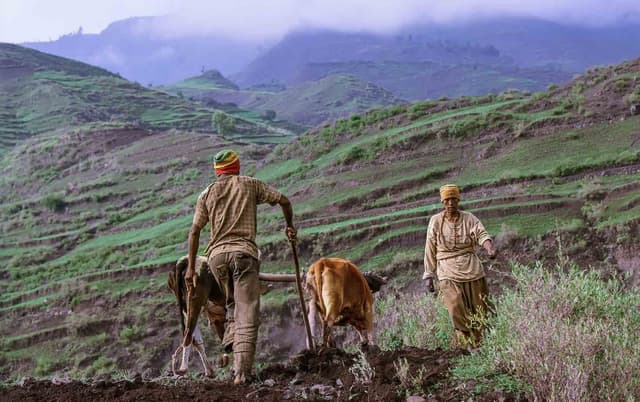
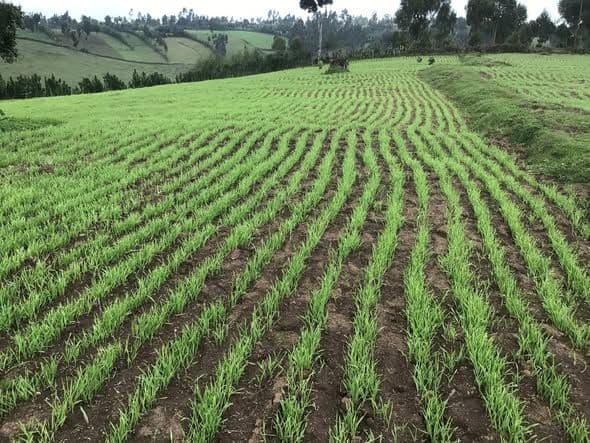
The land in Sidama’s highlands is rich with memory, terraced hills planted with wheat, coffee, bamboo thickets swaying in the wind, and false-banana groves that feed entire families. But beneath this abundance lies a quiet crisis. Soil acidity is steadily eroding the region’s productivity, leaving farmers struggling to maintain yields as each season takes its toll.
Kassa Kefelegn, a farmer from Luda kebele in Hagere Selam, a few hours’ drive from the region’s capital, says the soil has changed. His 20 hectares once yielded maize, wheat, and avocados with minimal fertilizer. Over the past few years, however, output has dwindled, even as input costs have climbed.
“I think the fertilizer has made the acidity worse,” he told Shega.
Heavy rains have washed away basic soil elements, while nitrogen-based fertilizers have accelerated acidification. Kassa says he now earns barely enough from his harvest to cover his family’s living expenses. Last year, officers from the regional agriculture bureau visited his farm with what they described as a longer-term remedy.
Under a pilot program, Kassa received OC-Massa, a TSP-enhanced fertilizer with a high phosphorus content, at no cost. The initiative, backed by OCP Ethiopia, the local subsidiary of Morocco’s state-owned fertilizer manufacturer, has enrolled about 40 farmers in the area. Organized into clusters, they are applying the customized input in hopes of restoring their yields.
OC-Massa combines soluble TSP, which supplies readily available phosphorus, with granulated limestone that neutralizes acidity in the root zone, blending elements of fertilizer and lime in a single application.
For Kassa, the proof will come at harvest.
“I produced three quintals per hectare last year,” he says. “I am expecting it to double.”
Soil acidity is becoming an increasingly serious threat to agricultural productivity across Ethiopia. Recent studies suggest that as much as 43 percent of the country’s arable land is now acidic. The Ministry of Agriculture launched a national lime initiative several years ago, aiming to treat roughly 300,000 hectares over a decade. Despite reallocating about 1.4 billion Birr from fertilizer subsidy budgets in 2024, the program has struggled to secure enough lime.
Treating a single hectare requires between 20 and 30 quintals, depending on the severity of acidification, posing daunting logistical and financial challenges for a country with limited resources.
In Sidama, the problem has continued to worsen. During the last farming season, regional authorities spent 60 million birr on lime purchases. Memru Moke, head of the region’s agriculture bureau, says about 62 percent of Sidama’s 152,000 hectares of arable land is now acidic. Officials hope that OC-Massa, by combining lime and fertilizer, may offer some relief.
For farmers like Zerihun Desta, there are few alternatives. Cultivating six hectares inherited from his father, the father of three depends on his shrinking harvest both for household consumption and income.
“The crops look better than last year,” he says. “We will have to wait and see.”
Temesgen Desalegn, an agro-economist, stresses the need to experiment with multiple approaches to address the urgency of soil acidity. So far, he notes, only about 10 percent of the planned land is treated each year.
“We keep ploughing the same land without treating it at all,” he told Shega.
He hopes the OC-Massa pilot can evolve into a sustainable source of relief for farmers nationwide. Scaling it up, however, will demand significant investment and long-term commitment as it moves beyond the pilot phase
👏
😂
❤️
😲
😠

Daniel Metaferiya
Daniel Metaferiya is a writer, journalist and radio host, with a keen interest in technology. He follows developments in Ethiopia's startup ecosystem closely and is passionate about profiling unique MSMEs.
Your Email Address Will Not Be Published. Required Fields Are Marked *